AHMADIS PERSECUTED ON EID  

Ahmadi Muslims Prevented from Offering Eid Prayers Across Punjab, Pakistan  

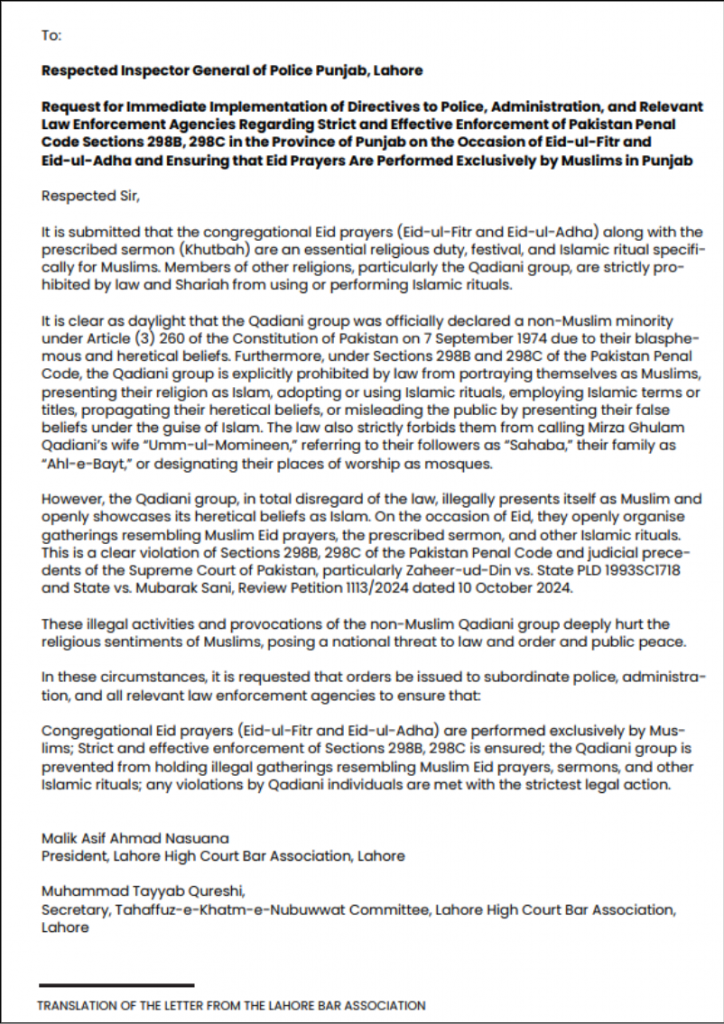
On the occasion of Eid-ul-Fitr, Ahmadi Muslim worshippers across multiple districts in Punjab were prevented from offering Eid prayers following coordinated actions by local authorities.  

Police entered Ahmadi Muslim mosques, forcibly removed congregants, and shut down mosques, in some cases locking the premises to prevent further use. These measures effectively denied the community the ability to observe one of the most significant religious occasions and constitute a serious restriction on religious practice. 

Acting on instructions attributed to the provincial administration, Punjab Police intervened at several locations on the morning of Eid, dispersing worshippers and vacating mosques. Community members reported harassment and coercive measures aimed at preventing congregational prayers.  

Documented incidents include: 

  • the prohibition of Eid prayers in Gujranwala,  
  • the prevention of Eid prayers at six locations in Sialkot,  
  • the forced evacuation of an Ahmadi mosque in Faisalabad prior to Eid prayers, and  
  • the clearing and sealing of multiple Ahmadi mosques in Sargodha.  

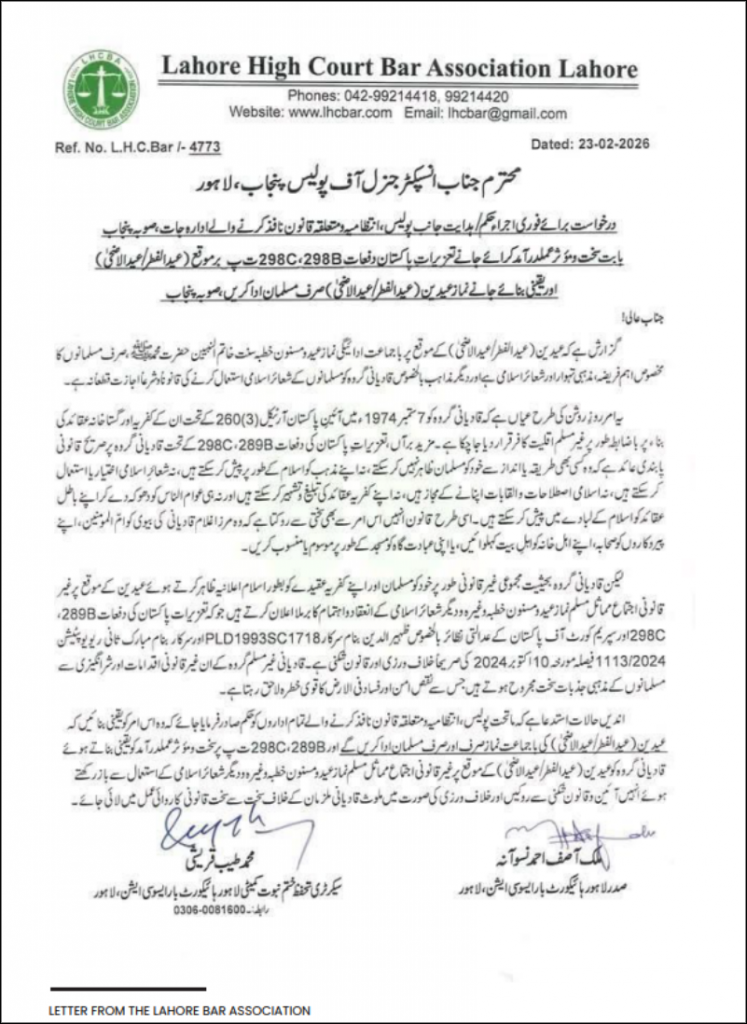
The enforcement measures form part of a broader pattern of administrative restrictions on Ahmadi Muslims, including the use of police to restrict worship within private premises and targeted action during significant religious events. The incidents also reflect a failure to implement established legal protections, including the Supreme Court of Pakistan’s ruling of 12 January 2022 affirming the right of Ahmadi Muslims to practise their religion within their mosques. 

Preventing Ahmadi Muslims from offering Eid prayers engages core protections under domestic and international law, including Article 20 of the Constitution of Pakistan and Article 18 of the Universal Declaration of Human Rights, both of which guarantee the right to practise and manifest religion. The actions of the police and local administration represent a direct restriction on religious observance within private premises and are inconsistent with these legal standards. 

For over 50 years, Ahmadi Muslims have been targeted by constitutional and social discrimination in Pakistan, yet the developments of this Eid reveal a worsening crisis.  

The coordinated sealing of mosques, denial of fundamental worship rights, and imposition of baseless arrests represent a serious escalation of anti-Ahmadi sentiment.  

These actions violate both Pakistan’s constitutional commitments to religious freedom and internationally recognised human rights standards. 
Source: Ahmadiyya Muslim Community UK.

We are using cookies to give you the best experience. You can find out more about which cookies we are using or switch them off in privacy settings.
AcceptPrivacy Settings

GDPR

This Cookie Policy explains how Ahmadiyya Muslim Association UK (AMA UK)  Limited (“company”, “we”, “us”, and “ours”) use cookies and similar technologies to recognize you when you visit our websites, including without limitation www.ahmadiyyauk.org and its mobile or localized versions and related domains / sub-domains (“Websites”) and/or our mobile application (“App”). It explains what these technologies are and why we use them, as well as your rights to control our use of them.

What are cookies?

Cookies are text files containing small amounts of information which are downloaded to your computer or mobile device when you visit a website or mobile application. Cookies are then sent back to the originating site on each subsequent visit, or to another site that recognizes that cookies. You can find out more information about cookies at www.allaboutcookies.org.

Cookies are widely used in order to make sites work or to work more efficiently.

We use cookies to enhance the online experience of our visitors (for example, by remembering your visits and/or page preferences) and to better understand how our site is used. Cookies may tell us, for example, whether you have visited our site before or whether you are a new visitor.

Cookies can remain on your computer or mobile device for different periods of time. Some cookies are ‘session cookies’, meaning that they exist only while your browser is open. These are deleted automatically once you close your browser. Other cookies are ‘permanent cookies,’ meaning that they survive after your browser is closed. They can be used by the site to recognize your computer or mobile device when you open your browser and browse the Internet again.

Why do we use cookies?

We use cookies for several reasons. Some cookies are required for technical reasons in order for our Websites and/or App to operate, and we refer to these as “essential” or “strictly necessary” cookies. Other cookies also enable us to track and target the interests of our users to enhance the experience on our Websites and/or App. Third parties serve cookies through our Websites and/or App for analytics and other purposes such as Google Analytics. In particular, we use forms related cookies which when you submit data through a form such as those found on contact pages or comment forms cookies may be set to remember your user details for future correspondence.

How can you control cookies?

You have the right to choose whether or not to accept cookies and we have explained how you can exercise this right below. However, please note that if you do not accept our cookies, you may experience some inconvenience in your use of our site.

You can set or amend your web browser controls to accept or refuse cookies. As the means by which you can refuse cookies through your web browser controls vary from browser-to-browser, you should visit your browser’s help menu for more information.

How often will we update this Cookie Policy?

We may update this Cookie Policy from time to time in order to reflect, for example, changes to the cookies we use or for other operational, legal or regulatory reasons. Please, therefore, re-visit this Cookie Policy regularly to stay informed about our use of cookies and related technologies.